In the last article, we discussed the 12 rashis (zodiac signs) and the Navagrahas in the Bhachakra (9 plants) that are a crucial part of Hindu Astrology.
In Vedic Astrology, the Jataka (horoscope) is a visual representation of the 9 planets and their alignment at a specific moment of time shown on a particular chart. This chart is called as Jataka.
During the time of a person’s birth, the degree of the Rashi and Nakshatra pada which is rising on the eastern horizon is known as the Lagna. In western astrology, the Lagna is know as the ascendent. In other words, the Lagna is the point of the zodiacal belt that coincides with the position of the horizon at the time of birth at the specific birthplace. This is also known as the Udaya or Janma Lagna.
To calculate lagna of a person, three important factors are very important. They are
1. Time of birth
2. Date, month and year of birth
3. Place of birth. The Janma lagna differs from latitude to latitude. Therefore latitude and longitude are very important for calculations.
Like the Uday/Janma Lagna, there are other Lagans like Chandra Lagna, Soorya Lagna, etc. The rashis here are occupied by Chandra, Soorya, and other planets. The Lagna is one of the most important and influential signs on the jataka as it determines one’s characteristics, personality, health, and many more crucial aspects of life. Janma Lagna is considered the first bhava (house) of the jataka, and the enumeration of the other bhavas follows the rest of the zodiac signs in sequence. Therefore, it not only represents the rising rashi, but also all the other bhavas in the chart.
Difference between rashi (signs) and bhava (houses)
The twelve signs of the zodiac should not be confused with the twelve houses of the horoscope. The twelve houses are divisions of a Jataka and always occupy the same place from lagna. The signs or rashis are sections in Bhachakra (zodiac belt). Due to the Earth’s motion on its own axis, they are constantly revolving from east, over the meridian to the west. The houses are numbered from one to twelve from lagna. The rashis are recognized by names such as mesha, vrushabha and so on.
Signification of houses
First bhava (house): Tanu bhava represents self
Second bhava (house): Dhana bhava represents wealth
Third bhava (house): Bhratru bhava represents siblings
Fourth bhava (house): Matru bhava represents mother and family
Fifth bhava (house): Santana bhava represents children
Sixth bhava (house): Ripu bhava represents illness and disease
Seventh bhava (house): Kalatra bhava represents marriage and domestic life
Eighth bhava (house): Ayushya bhava represents longevity
Ninth bhava (house): Bhagya bhava represents fortune and religious acts
Tenth bhava (house): Karma bhava represents profession
Eleventh bhava (house): Labha bhava represents desires, hopes and aspirations
Twelfth bhava (house): Vyaya bhava represents loss and sufferings
A learned astrologer can predict life events based on planetary positions in different houses.
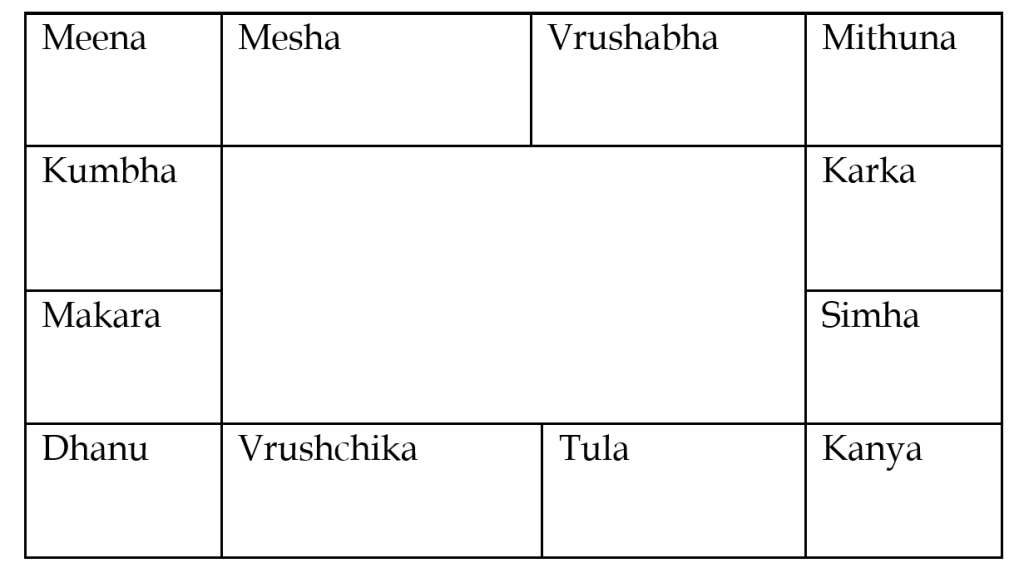
There are several different ways of writing a jataka. Southern India uses nirayana system (paddhati). In this type of chart, the placement of the rashis don’t change and are permanent. In this system the reading or counting of houses is clockwise.
In Eastern and Bengal region, they use sayana system (paddhati) for recording planetary positions in Jataka. In this system the houses changes for each different lagna and the reading or counting of houses is anticlockwise. This is Kanya lagna Jataka and lagna comes in center.

People in northern India also use sayana system for recording the planetary positions in Jataka. It looks like as below. This is Mesha lagna Jataka and lagna comes in center.

Even though the way of writing Jatakas are different in different regions, the predicting techniques and other sutras (formulas) from different Granthas (original texts) are similar throughout India.

 Jataka Phala Saara